
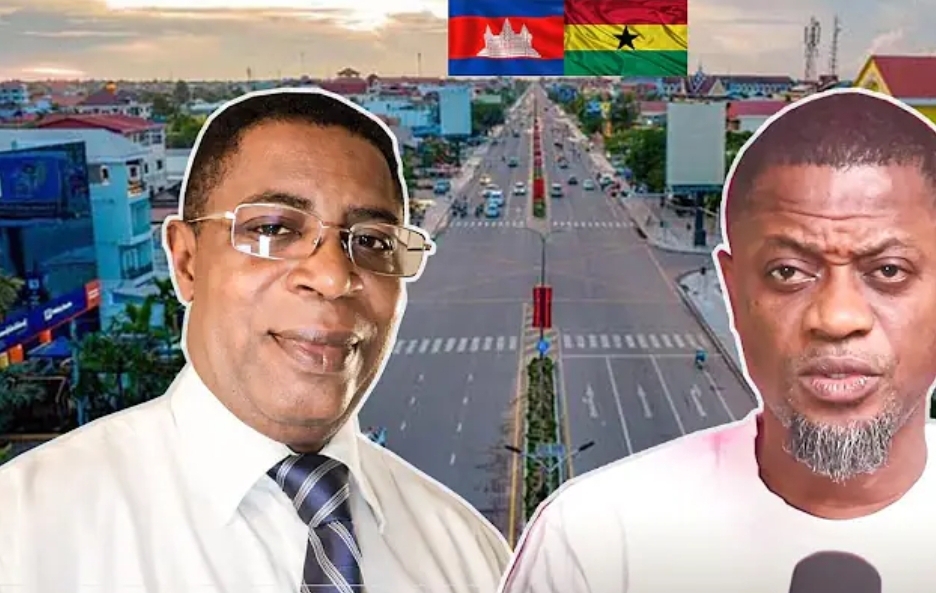
Asiamah, a Ghanaian Based in Cambodia, Shares His Life Journey on SVTV Africa’s Daily Hustle Worldwide
Asiamah, a Ghanaian who has lived in Cambodia for over two decades, recently appeared on SVTV Africa’s Daily Hustle Worldwide show with DJ Nyaami, where he shared his long journey abroad, his experiences as a foreigner, and the challenges facing Ghanaians in Cambodia.
According to Asiamah, he left Ghana more than 40 years ago after completing school. His first stop was Nigeria, where he obtained a certificate before continuing his search for better opportunities abroad. Over the years, he traveled extensively, visiting South America, Taiwan, Korea, and Japan before finally settling in Cambodia.
“I’m originally from Mampong in the Ashanti Region,” he said. “After leaving Japan, I gathered my things, moved to Taiwan, and eventually came to Cambodia, where I’ve lived for over 20 years.”
Asiamah revealed that he recently returned to Ghana and was disturbed by reports of Ghanaians traveling to Cambodia to engage in internet fraud. He recounted sitting on the same flight with individuals who later turned out to be victims of scamming.
“On our return to Cambodia, they told me they worked there,” he explained. “I warned them to be careful because there are serious crackdowns in Cambodia. Some crime networks operate in places like Sihanoukville, and arrests happen all the time, although no Black person has been arrested so far.”
Despite the challenges, Asiamah believes life in Cambodia can be manageable if one stays disciplined and lawful. “It’s not easy, but if you do your work well, you can survive,” he noted.
He disclosed that over 150 Ghanaians are currently stranded in Cambodia due to immigration issues. According to him, overstaying a visa attracts a fine of $6 per day in the first month, which increases to $10 per day from the second month onward.
“There are really no jobs for foreigners here,” he said. “I’ve survived because I teach in private schools and run my own business. Discrimination exists, and language is a major barrier.”
Asiamah, who speaks from experience, stated that Cambodia remains his best option compared to other countries he has lived in, including Japan, Taiwan, and Korea. However, he stressed that without speaking the local language, survival becomes difficult, especially in trading.
“If you don’t speak the language and you’re selling, people won’t buy from you,” he said.
On his family life, Asiamah revealed that he has children in both Ghana and Cambodia. His children in Ghana are aged 44 and 42 and already have families of their own, making him a grandfather and great-grandfather. He also has two children with a Cambodian woman.
He expressed frustration with the slow response of Ghanaian embassies, particularly the Ghana Embassy in Malaysia, which handles consular services for Ghanaians in Cambodia.
“The embassy response is very slow,” he complained. “Most of the workers are Indians and Malaysians, and the service is poor. I tried to get Ghanaian passports for my children, but it has been very difficult. The consular officers are not serious at all.”
Asiamah also revealed that, to date, he has been unable to secure Ghanaian passports for his children born in Cambodia, making it impossible for them to travel to Ghana. He expressed deep concern over the situation, noting that despite multiple efforts through the appropriate channels, the process has stalled.
“My children cannot come to Ghana because they don’t have Ghanaian passports,” he said. “But I really want them to go to Ghana, know their roots, and experience where I come from.”
Asiamah further explained that Cambodia does not grant citizenship easily, even to foreigners with children born in the country. Foreigners are required to renew their visas annually, and the government does not consider family ties when enforcing immigration rules.
“They don’t care whether you have children here or not,” he said. “There are many jobs reserved strictly for citizens, not foreigners.”
He added that foreigners cannot own land outright unless they purchase condominiums. However, he noted that he has managed to build a stable life for himself.
“I bought my house here, I teach, I do business, and no one controls me,” he said. “I plan to apply for another visa or relocate so I can eventually bring my children to Ghana. I want them to know their home.”
Asiamah concluded by calling on Ghanaian authorities to improve embassy services abroad, emphasizing that many Ghanaians overseas are struggling due to delays and poor consular support.
Watch The Video Below:
About The Author


